
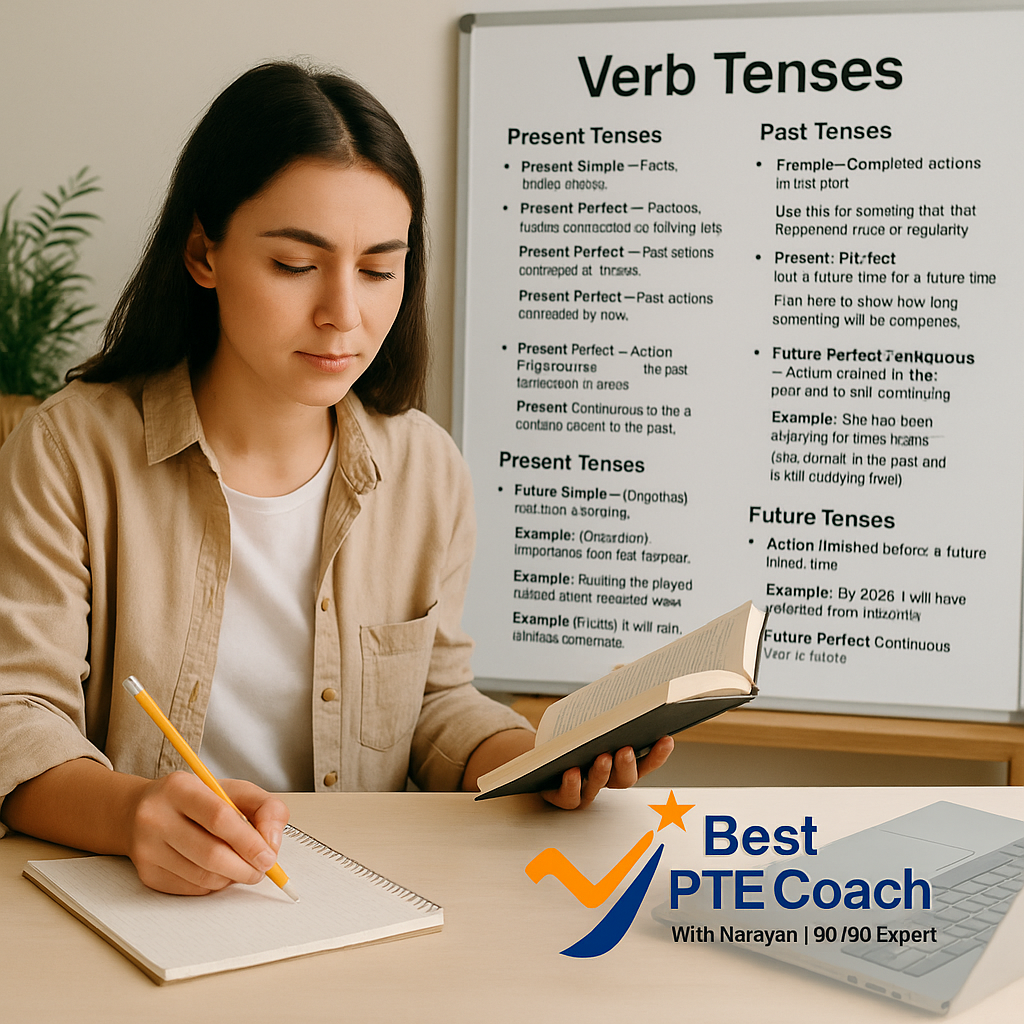
English has 12 tenses. Each tense shows when an action happens (past, present, future) and what kind of action it is (finished, ongoing, repeated, or linked to another time).
✅ Simple Tenses
🔹 Present Simple → Facts, habits, truths
Use this for things that are always true, happen regularly, or are general facts.
- Formula: Subject + V1 (+s/es for 3rd person)
- Example (Fact): The Earth revolves around the sun.
- Example (Routine): She reads the newspaper every morning.
- Example (Truth): Water boils at 100°C.
🔹 Past Simple → Completed actions in the past
Use this for something that happened once or regularly in the past.
- Formula: Subject + V2
- Example (One action): They visited Paris last year.
- Example (Routine): He played football every weekend when he was young.
🔹 Future Simple → Decisions, predictions, future facts
Use this for things you decide now, or predictions about the future.
- Formula: Subject + will + V1
- Example (Decision): I will help you with your homework.
- Example (Prediction): It will rain tomorrow.
- Example (Fact): The sun will rise at 6 am.
✅ Continuous (Progressive) Tenses
🔹 Present Continuous → Actions happening now / temporary actions
Use this for something happening right now, or for short-term situations.
- Formula: Subject + am/is/are + V1+ing
- Example (Now): He is watching TV right now.
- Example (Temporary): I am staying with a friend this week.
🔹 Past Continuous → Ongoing actions in the past
Use this to describe something that was happening at a specific time in the past.
- Formula: Subject + was/were + V1+ing
- Example: At 9 pm, I was reading a book.
🔹 Future Continuous → Ongoing actions in the future
Use this for something that will be happening at a specific time in the future.
- Formula: Subject + will be + V1+ing
- Example: This time tomorrow, I will be travelling to Melbourne.
✅ Perfect Tenses
🔹 Present Perfect → Past actions connected to now
Use this for something that started in the past but still matters in the present.
- Formula: Subject + has/have + V3
- Example: They have finished their homework. (The homework is done now.)
- Example: I have lived in Sydney for five years. (I still live there.)
🔹 Past Perfect → An action finished before another past action
Use this to show the “earlier past”.
- Formula: Subject + had + V3
- Example: She had left before I arrived. (Her leaving happened first.)
🔹 Future Perfect → Action finished before a future time
Use this to show something will be completed before a deadline.
- Formula: Subject + will have + V3
- Example: By 2026, I will have graduated from university.
✅ Perfect Continuous Tenses
🔹 Present Perfect Continuous → Action started in the past and is still continuing
Use this to show how long something has been happening.
- Formula: Subject + has/have been + V1+ing
- Example: She has been studying for three hours. (She started in the past and is still studying now.)
🔹 Past Perfect Continuous → An ongoing action before another past event
Use this to show how long something was happening before another event.
- Formula: Subject + had been + V1+ing
- Example: They had been waiting for two hours before the bus came.
🔹 Future Perfect Continuous → Ongoing action continuing until a future time
Use this to show how long something will continue into the future.
- Formula: Subject + will have been + V1+ing
- Example: By next month, she will have been working here for five years.
🎯 Why This Matters in PTE
- Simple Tenses → Best for facts, arguments, and charts (The graph shows…).
- Continuous Tenses → Good for describing actions in progress (The company is expanding…).
- Perfect Tenses → Show results or links to now (Scientists have discovered…).
- Perfect Continuous Tenses → Less common, but useful in essays and RTS (Respond to a Situation) for describing ongoing trends.
Leave a Reply